
The F-Stop
- Tinus Diedericks

- Apr 20
- 4 min read
In discussions about camera performance, particularly in professional imaging, surveillance, and perimeter-security applications, the conversation often gravitates toward resolution, sensor size, artificial intelligence, or analytics. Yet one of the most decisive optical parameters is frequently misunderstood or underestimated: The F-stop. Far from being a simple exposure setting, the f-stop governs how a lens behaves in light, how reliably it focuses, how much of a scene remains sharp, and how consistent a camera will perform across day and night conditions. In practice, the f-stop is not merely a photographic convenience; it is an optical authority that quietly determines whether an image is usable, reliable, and defensible

At its core, the f-stop, also known as the f-number, is a mathematical ratio. It is defined as the focal length of a lens divided by the diameter of its entrance pupil. This ratio is dimensionless, meaning it applies equally regardless of lens size. A lens set to f/2 has an aperture diameter equal to half its focal length; at f/4, the diameter is a quarter of the focal length. This simple relationship has profound consequences. A smaller f-number corresponds to a physically larger aperture, allowing more light to reach the sensor, while a larger f-number restricts light by reducing the aperture opening.
The familiar f-stop scale f/1.4, f/2, f/2.8, f/4, f/5.6, f/8, f/11, f/16 is not arbitrary. Each full stop change represents a doubling or halving of the amount of light entering the camera. This progression exists because light transmission depends on the area of the aperture, not its diameter, and each step follows the square root of two. In practical terms, moving from f/2.8 to f/4 cuts the light reaching the sensor in half, while opening from f/4 to f/2.8 doubles it. This predictable relationship is fundamental to exposure control, but exposure is only the first layer of the f-stop’s influence.
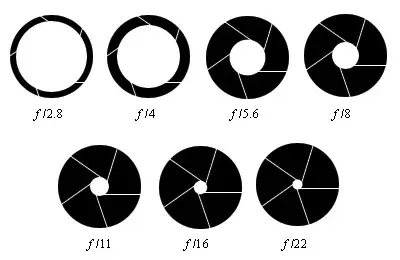
One of the most significant consequences of f-stop selection is its effect on depth of field, the zone of acceptable sharpness in front of and behind the point of focus. Wide apertures (low f-stops) produce shallow depth of field, isolating subjects while allowing foregrounds and backgrounds to blur rapidly. Narrow apertures (high f-stops) increase depth of field, keeping more of the scene in focus from near to far. In artistic photography, this property is often used creatively. In surveillance and security imaging, however, it becomes a matter of operational reliability. A shallow depth of field at night may cause a person to drift out of focus with only minor movement, while a deeper depth of field during the day ensures that fence lines, vehicles, and multiple targets remain simultaneously sharp.
The f-stop also plays a decisive role in optical performance and image sharpness. Every lens has a performance “sweet spot,” typically between f/4 and f/8, where aberrations are minimized and resolution is maximized across the frame. When a lens is used wide open, optical imperfections such as spherical aberration and reduced edge sharpness become more pronounced. When the aperture is stopped down too far, diffraction begins to soften fine detail. In high-resolution imaging systems, particularly those used for identification and forensic review, operating outside this optimal range can significantly degrade usable detail, even if the sensor itself is capable of much more.
Day-night operation exposes the f-stop’s importance more starkly than almost any other scenario. During daylight hours, abundant light allows the aperture to close down, increasing depth of field and masking minor focus errors. At night, the situation reverses. The camera must open the aperture to its lowest f-stop to collect sufficient light, dramatically reducing depth of field and tightening focus tolerance. This is why many fixed cameras appear perfectly sharp during the day but struggle at night, even when illumination seems adequate. The lens is operating at its most demanding optical condition, where even slight focus shifts or wavelength differences, especially between visible light and infrared, can cause noticeable softness. This reality underpins the widespread use of IR-corrected lenses in professional surveillance systems.
A common misconception is that f-stop alone defines the “size” of a lens opening in absolute terms. In reality, focal length matters just as much. A 25 mm lens at f/2 has a 12.5 mm aperture, while a 100 mm lens at f/2 has a 50 mm aperture. Both transmit the same relative amount of light to the sensor, but their depth of field characteristics and optical behaviour differ dramatically. In long-range perimeter surveillance, where telephoto lenses dominate, this relationship becomes critical. Long focal lengths combined with wide apertures create extremely narrow depth of field, demanding precise focus calibration and stable mounting to maintain consistent image quality
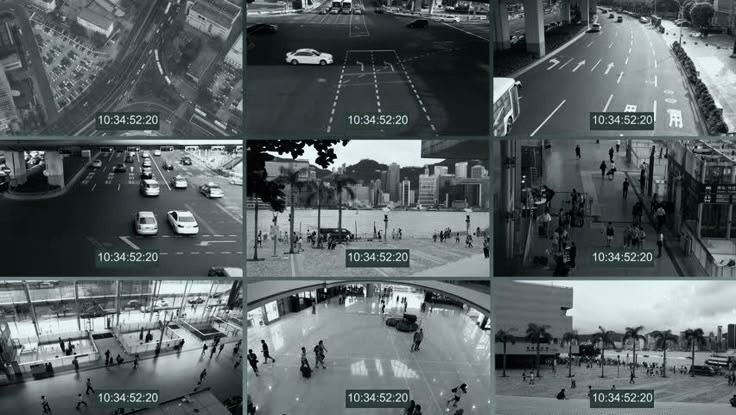
In security and perimeter-protection environments, mines, ports, borders, and critical infrastructure, the implications of f-stop choice are not academic. An inappropriate aperture can result in missed identification details, unstable night-time focus, increased motion blur, and degraded AI detection confidence. Modern analytics rely on clean edge definition, contrast stability, and repeatable image geometry. When the f-stop forces the lens to operate outside its optimal conditions, even the most advanced AI models struggle to compensate.
The practical lesson is that f-stop selection must be intentional and contextual. Long-range perimeter cameras often benefit from fast lenses in the f/2 to f/2.8 range to preserve night-time detection capability. Fence-line overviews typically perform best between f/4 and f/5.6, balancing light intake with sufficient depth of field. Identification choke points, where sharpness and consistency matter more than sheer brightness, are often best served in the f/4 to f/8 range. In bright coastal or desert environments, stopping down further helps manage glare and maintain optical stability.
Ultimately, the f-stop is far more than a brightness control. It is a governing parameter that shapes exposure, focus behaviour, optical sharpness, and operational reliability, especially under the demanding conditions faced by professional imaging systems. In an era increasingly defined by sensors, software, and artificial intelligence, the f-stop remains a reminder that the fundamentals of optics still rule the outcome. Ignore it, and performance becomes unpredictable. Respect it, and the entire imaging chain becomes more stable, more accurate, and more trustworthy
By Tinus Diedericks
CEO of Timeless Technologies

Comments